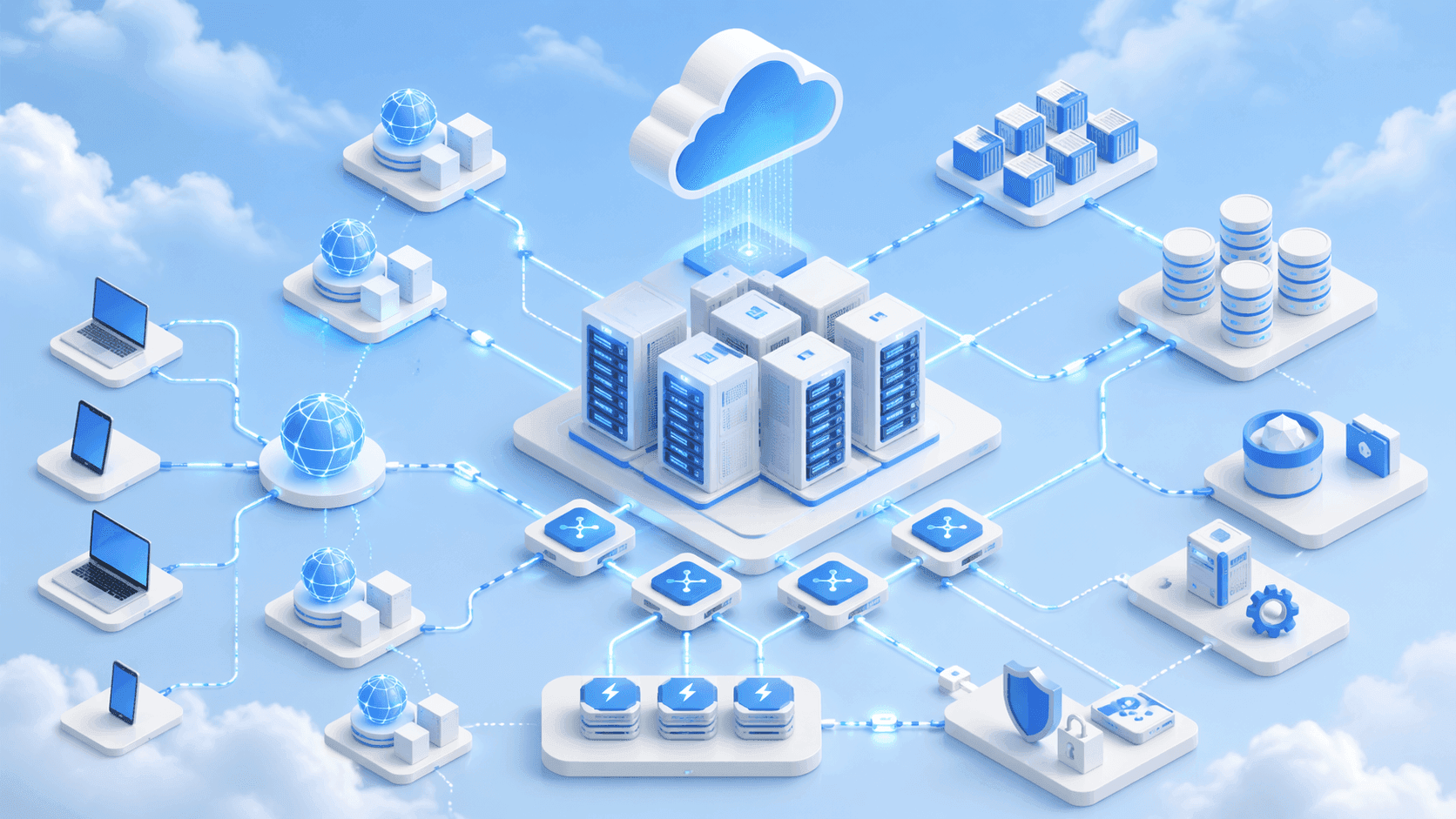
Building a web application that works for 100 users is a different engineering challenge from building one that works for 100,000. The decisions you make about architecture, technology stack, and development practices in the early stages determine how gracefully - or catastrophically - your application handles growth.
This guide covers the key architectural principles, technology choices, and engineering practices that make web applications genuinely scalable - from initial build through real-world growth.
Define "Scalable" for Your Context
Scalability is not a single dimension. Different applications have different scaling challenges:
- Traffic scalability: Handling more concurrent users and requests without degrading response times.
- Data scalability: Storing and querying growing datasets efficiently.
- Feature scalability: Adding new functionality without creating architectural debt that slows future development.
- Team scalability: Enabling more developers to work on the codebase without constant conflicts and integration failures.
Understanding which dimensions matter most for your application shapes the right architectural decisions. A content platform has different scaling requirements than a transactional SaaS product.
Architectural Foundations
Separate Concerns Clearly
The most scalable architectures are the ones where different concerns - presentation, business logic, data access - are separated clearly. This is not about micro-services for their own sake. A well-structured monolith with clear internal boundaries is more scalable in practice than a poorly designed distributed system.
The separation that matters most in most web applications is: frontend (what users see), API layer (business logic and access control), and data layer (storage and retrieval). Each layer should be independently deployable and testable.
Design Your API First
Your API contract - the endpoints, request/response shapes, and authentication model - is the most important design decision in a multi-interface application. A well-designed API supports multiple clients (web, mobile, third-party integrations) without modification. A poorly designed API forces breaking changes every time requirements evolve.
RESTful APIs are appropriate for most applications. GraphQL is valuable where clients have highly variable data needs and you want to avoid over-fetching. Design the API to reflect your domain, not your database schema.
Stateless Application Servers
Application servers that store session state locally cannot be horizontally scaled - adding a second server instance means sessions on the first instance are inaccessible to requests handled by the second. Stateless servers - where all session state is stored externally (in a database or cache like Redis) - can be scaled horizontally by adding instances, with load balancing distributing requests across all of them.
Technology Stack Decisions
Frontend: React, Next.js, Angular, or Vue.js
The modern frontend landscape offers several mature, production-proven frameworks. The right choice depends on your application's characteristics:
- Next.js (React): The dominant choice for new web applications. Excellent developer experience, server-side rendering, static generation, and incremental static regeneration for optimal performance. First-class TypeScript support. Strong for content sites, marketing pages, and full-stack web applications.
- Angular: A fully opinionated framework that provides structure out of the box. Excellent for large teams building enterprise applications where consistency and strong conventions matter. Steeper learning curve but lower architectural ambiguity at scale.
- Vue.js: An approachable, flexible framework with a gentler learning curve. Strong choice for teams transitioning from jQuery-era development and for applications where incremental adoption of a framework is needed.
Backend: Node.js, NestJS, or Express
Node.js is the standard choice for JavaScript-stack web applications. It handles high-concurrency I/O efficiently and shares the language ecosystem with the frontend.
- Express.js: Minimal and unopinionated. Fast to get started, but requires more architectural decisions from the team. Good for APIs that need flexibility.
- NestJS: Opinionated, TypeScript-first, and inspired by Angular's module system. Provides strong structure for large teams. Excellent for enterprise APIs and microservices.
Database: Relational vs. Document
Database selection should follow from your data model, not technology trends:
- PostgreSQL or MySQL: Relational databases with ACID guarantees. Excellent for transactional data, complex queries, and data with well-defined relationships. Strong for financial data, user accounts, and anything requiring referential integrity.
- MongoDB: Document-oriented database. Flexible schema is valuable when data structures evolve frequently or when documents are naturally hierarchical. Good for content management, product catalogues, and applications with varied data structures.
- Redis: In-memory data store used for caching, session storage, rate limiting, and pub/sub messaging. Dramatically reduces database load and improves response times for frequently accessed data.
Performance Engineering
Database Query Optimisation
Most web application performance problems originate in the database. The three most impactful optimisations are: proper indexing (queries that filter or sort on unindexed columns perform a full table scan), query result caching (using Redis or application-layer caching for expensive, frequently repeated queries), and connection pooling (reusing database connections rather than creating new ones for each request).
CDN for Static Assets
Static assets - images, fonts, CSS, JavaScript bundles - should be served from a Content Delivery Network (CDN) with appropriate caching headers. This shifts asset delivery to edge servers close to users, reduces load on your application servers, and dramatically improves load times for global users.
Background Processing
Any operation that takes more than a few hundred milliseconds - sending emails, processing files, calling external APIs, generating reports - should be handled asynchronously via a background job queue (Bull, BullMQ, or similar). This keeps your API responsive while long-running work completes in the background.
Infrastructure and Deployment
Cloud Infrastructure
AWS, Google Cloud, and Azure all provide the managed services needed to run a scalable web application: managed databases, object storage, CDN, container orchestration, and serverless compute. The right choice depends on your team's existing expertise and any organisational constraints.
Containerisation with Docker
Containerising your application with Docker ensures consistent environments across development, staging, and production. It simplifies deployment, makes horizontal scaling easier, and provides isolation between services. Kubernetes (or managed alternatives like AWS ECS) handles container orchestration at scale.
CI/CD Pipelines
Automated testing and deployment pipelines are essential for teams that want to ship reliably and often. A solid CI/CD pipeline runs tests on every pull request, builds and stages changes automatically, and deploys to production through a controlled process - eliminating manual deployment errors and reducing the time between code completion and user availability.
Scalable Web Development with Savyasachi Infotech
At Savyasachi Infotech, we design and develop web applications built for real-world scale. Our architecture decisions are grounded in your specific requirements - not in trends or over-engineering. We work with React, Next.js, Angular, Node.js, Express, NestJS, PostgreSQL, MongoDB, and AWS/GCP/Azure to build systems that perform, scale, and remain maintainable as they grow.
If you are building a web application and want to get the architecture right from the start, talk to our team.
Monitoring and Observability in Production
A scalable web application needs observability infrastructure that allows your team to understand what is happening in production in real time. This means centralised logging (tools like AWS CloudWatch, Datadog, or Elastic Stack), application performance monitoring (APM) to trace slow requests and identify bottlenecks, error tracking (Sentry or similar) to catch and diagnose production errors before users report them, and infrastructure metrics to monitor CPU, memory, and database resource utilisation.
Observability is not a luxury - it is the mechanism by which you detect and diagnose performance problems before they affect users at scale. Teams that build without observability find themselves debugging production incidents with limited information, which is slow, stressful, and damaging to reliability. Budget time for observability setup as a first-class engineering concern, not an afterthought.
Build Your Web Application on a Foundation That Scales
The architecture decisions you make in the first weeks of a web application project determine how easily it scales, how safely it handles real user data, and how quickly your team can ship new features in year two and beyond. Getting these decisions right at the start is far cheaper than rearchitecting later.
At Savyasachi Infotech, we design and develop scalable web applications using React, Next.js, Angular, Node.js, NestJS, PostgreSQL, MongoDB, and AWS, GCP, and Azure infrastructure. We bring architectural thinking to every engagement - not just code delivery - and we build systems designed to grow with your business.
Book a free consultation and describe what you are building. We will review your requirements, recommend the right architecture and stack, and give you a clear plan for building something that holds up as you scale.